Tuesday, September 26, 2017

STANDARDS FOR TOW LINE STRENGTH ARE EVOLVING TOWARDS GREATER SAFETY FACTORS

Of Interest To Professional Mariners, Admiralty Expert Witnesses, and Lawyers

THE GREAT NAMAZU EXPLAINS RECENT EVOLUTION IN DETERMINING THE SAFETY FACTORS FOR TOW LINE (SYSTEM) STRENGTH 

The Great Namazu, 3,000 years of nautical experience in one analyst

GREETINGS SAILOR BIPEDS  
Back in the day when the Great Namazu was a pup mariners talked of "tow lines". Today with the advances in cordage technology and innovations in chafe protection, and winch technology several different types and sizes of line or wire might be utilized in a "towing system". Back in the day, Tow Masters, Mates, Boatswains often considered the "safety factor" when arranging for a tow. There was usually only one line, the "tow line" or hawser to consider, now "towing systems" rarely lend themselves to one size fits all "safety factors". Each system component line must be considered separately such as pendant, mainline, and backer"

 The towing systems we used to simply call the tow line or towing hawser or wire is perhaps the single most critical component in a towing operation. Once connected, the towing vessel, her officers and owners usually have responsibility for the towed vessel or vessels. Tows can result in disaster for a variety of reasons. Miscalculated stability resulting in the capsize of either the towing vessel or the towed vessel and failure of the "tow line" (towing system) are two of the most common causes of casualties in the marine towing industry. In this post we will deal with avoiding the broken towing line(s) (system). Such avoidance is tougher than it used to be and fixing liability in the wake of such a failure is more difficult than ever. The expert witness in admiralty who cites to the "custom of the Industry" is probably skating on thin ice today and may often be impeached by an expert who understands codes, standards, standards of instruction, and the ongoing evolution in standards in the towing game today. 
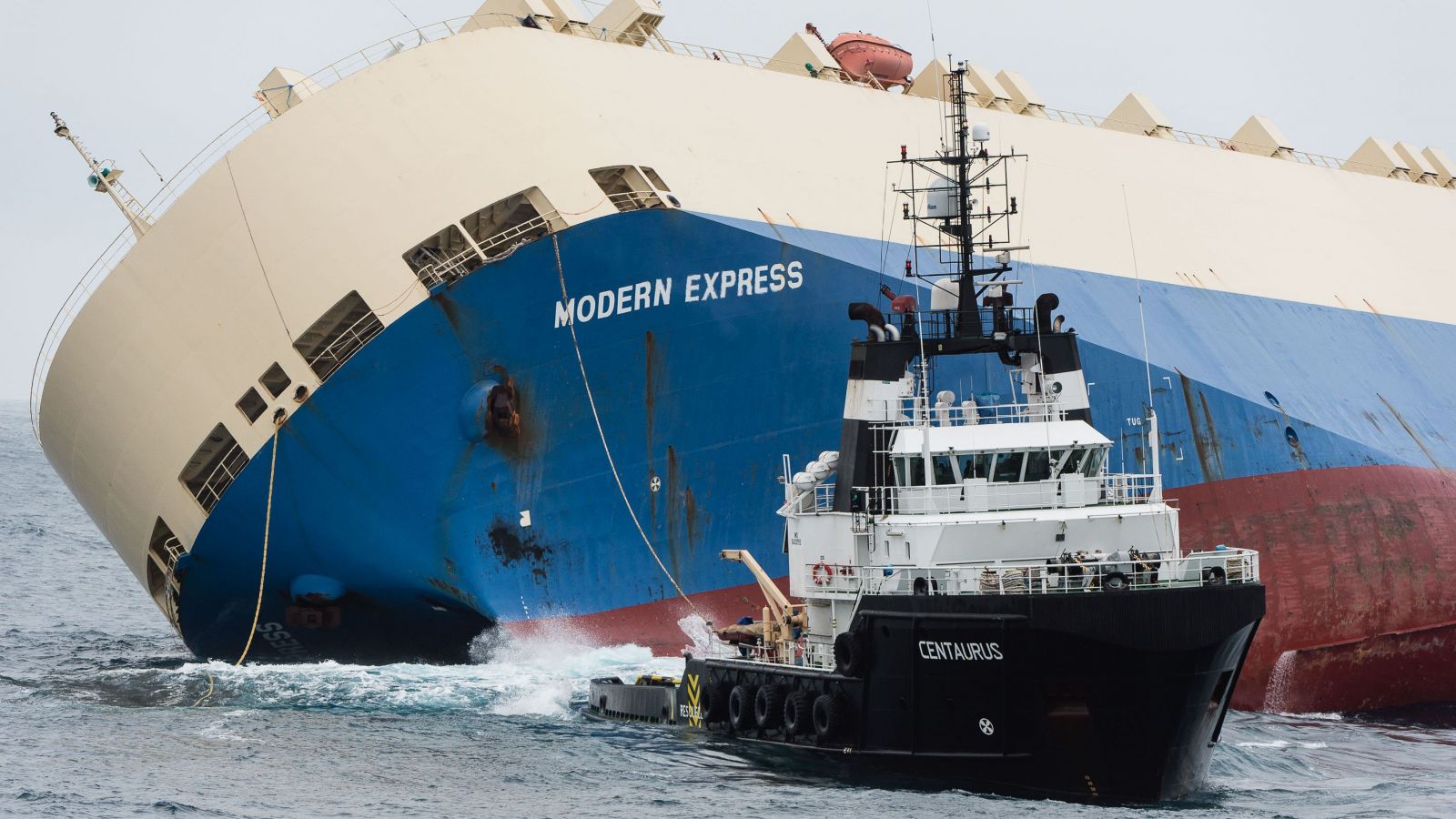


Image Courtesy French Ministry Of Defense / Marine Nationale

Back in the day we learned certain concepts like "breaking strain" and "safe working load". The key to safety in most marine operations involving "rigging" (line, wire, blocks and tackle , etc.) from mooring to towing, and working men aloft was insuring that you used the right strength of line for the job at hand. Most cordage and wire came with a labeled "breaking strength or strain" and a frequent rule of thumb in simpler applications such as mooring was to select cordage with a breaking strain half again the weight of the load,  For towing often twice the weight or "strain" of the load", for working with men aloft we never went up without a boatswains chair supported by a line that could bear seven times our weight and tools. Things have changed faster than the authoritative literature.

 When an American Merchant Marine Officer takes takes the various Coast Guard administered professional license exams the questions are based on certain publications considered classic and reliable such as KNIGHTS MODERN SEAMANSHIP,  and such works are also considered in determining the standards of instruction for nautical training institutions. But often such classics are twenty years or more behind the times in certain areas. Not all aspects of the nautical arts and sciences are classic and few are static. Applying an obsolete "rule of thumb" to a particular rigging problem and then losing your tow is not a legally acceptable excuse. When you suspect that the classic textbook computations and recommended safety factors may not apply we suggest that you look to the towing system's manufacturer's literature. If you are applying and operating a towing system within the designer's and manufacturer's safety parameters it will be difficult for a board of inquiry, or admiralty court to find liability or negligence in your action. Unfortunately an all too common "custom of the Industry" is to lose or never have delivered to the tug the manufacturers manuals. Fortunately it is becoming more common to have access to a computer or smart phone on board. Some of the best cordage manufacturers and distributors have their rigging manuals available on line. One Such is SAMSON ROPE USERS MANUAL: 
http://www.samsonrope.com/Documents/Rope_Users_Manual_WEB.pdf  )

 Over the years as I have observed sailor biped behavior I've noted that many responsible bipeds such as Masters, Mates, and Boatswains have attempted to explain away accident causation with the equivalent of "there wasn't time to do it right", yet some how there always seems to be time to clean up the resulting mess and do it over. Maybe we should suggest a couple of twenty first century "Rules Of Thumb" while many of the standards of the nineteenth and twentieth century still around and all too uncritically followed. 

FIRST : If your "towing system" does not consist of some type of right laid three strand line of a single type from towing winch or deck fitting to towed vessel, suspect that the old rules of thumb are not going to work for you. Now think twice before you act. 

SECOND: If you do not know the manufacturer's breaking strain and safe working load, try to obtain it before proceeding. If the manuals are not on board and you have access to the internet, see if the information is posted on the manufacturers web site such as : SAMSON ROPE USERS MANUAL: 
http://www.samsonrope.com/Documents/Rope_Users_Manual_WEB.pdf  )

THIRD: If you feel you must operate and you can't find the pertinent data to accurately calculate safe working load remember two all important things. (1) Required safe working loads as a ratio of load to breaking strain for the latest types of cordage are much higher than in the past. If in similar but older applications you were safe with a multiple of 1.7 times over bollard pull or weight to be moved consider that 2.2 to 2.5 is probably the recommended safety factor today. In the past prudent tug operators purchased their new towing hawsers with safety factors of at least 5:1 over their continuous ahead bollard pull rating. With some line today a 7:1 rating may be recommended. (2) In the past we always reduced safe working load by age and condition of the line based on known criteria of visual inspection. Some news cordage gives no reliable and predictable visual indication of wear. In the old days when safe working load was reduced based on visual inspection to 50% of original (which was often 5 times the breaking strain of the new line) we replaced the towing line and the old one became fenders . Today some hawsers must be replaced based on service times, and a 30% reduction in hawser strength is grounds for replacement. In short ,service times are becoming shorter and required retained line strength as a percentage of original breaking strain is becoming higher. It is probably asking for an accident and the subsequent liability to operate a towline assembly at less than 70% of original strength ratings.

 So in an industry where suits ashore buy the cordage and don't know what to ask for at delivery to assure that crews have the information to properly calculate towline assembly strength what do you do? First ask for the manufacturer's manuals and contact information. Second start your own note book on your rigging, I mean you Captain, Mate, or Boatswain. Don't assume that any notebook you create won't grow legs and walk away after the next crew change. Dig for the information and learn to do the calculations, get the help you need and write everything down. Be sure to write the authoritative source of your information. When the day comes to ask the suits to replace that towing system after only 30% of strength loss which comes much faster than budgets typically anticipate you will have to defend your position. Learn how to use and inspect and compute safe working loads of modern cordage. Remember if the tow system cordage components you are looking at aren't right laid three strand, it is more probable than not that anything you had to regurgitate on the seamanship or marlin spike seamanship portion of your Coast Guard license or rating exam actually applies. 

 When ordering new line ask for:
* The exact cordage composition, lay, manufacturer,usage requirements, breaking strain. safety factors, any inspection hints.

* Copies of certifications of approval by Classification societies, any test certificates, and manufacturer's handling, storage and maintenance requirements.

* Material Safety Data sheets, these should accompany the spools of line when they are delivered aboard and contain inspection tips to aid you in knowing when you should refuse delivery of aged, discolored, or damaged line. 

 Start educating the suits. High tech cordage has fewer indicators of wear and has to be replaced more often. It also will require more crew training and time to handle safely. 

Tuesday, September 19, 2017

NO MORE ST.MARTIN's DAY IN DUSSELDORF, WATCH FOR CHRISTMAS TO BE SUPPRESSED NEXT

 The Great Namazu, Retired Japanese Demigod, writer, analyst, commentator, rock album cover model
 Hey European Bipeds!
  Hows that multiculturalism working out for you? Have you ever wondered why multiculturalism doesn't include your culture, you know the one that is native to your nation, the one that built your nation? Ever ask yourself why embracing "multiculturalism" means insulting, demeaning, dumbing down, your own culture, the one that was there first. As a 3,000 year old giant catfish I was there for the European Recognizance by sea of the world. It was the cultures, particularly the maritime cultures of Great Britain,  Spain, Portugal, and the Netherlands that literally helped the world discover itself and begin communication between and among cultures. Why is that not something to be proud of? Why do you feel in the Netherlands, Britain, France, Sweden, you must cease all celebration of your native cultures because it might offend the Muslims you have foolishly allowed among you.  News flash Euro Bipeds, the Muslims among you hate you and your very existence except as subservient cash cows for  their coming Sharia tax system to support Muslim welfare . 
 For crying out loud continue to celebrate your cultural traditions including and especially your Christian traditions. Will it offend the Muslims, yes of course. Will not celebrating that which you have a hard earned right to celebrate placate their anger in any way. Hell no, there are among you to conquer you. What should you do if they take offense? That depends on how they express their offense. Any breach of the peace and all participants should be kicked out of the country. This shouldn't be a difficult moral choice, you are under siege by agents of a devilish philosophy of conquest, when caught in the act such as civil disobedience and protest of your own culture and making demands that you conform to theirs they are caught being more than just boorish guests. This is sedition . Send them back to the hell holes they came from if they do not seek to integrate and become part of your society and culture. Here is a recent example of of Islamic social aggression and lefty Euro-biped acquiescence.
 A school in Oberkassel, which if memory serves is a suburb of Dusseldorf in Germany; has decided, in light of Islamic protest, to secularize their ancient traditional St. Martin Day celebration of November 11th and call it the "Festival of Light". In my memory of pre-Christian Europe there used to be a number of festivals of light. Most occurred between November 11th and December 26th. 
File:Bundesarchiv Bild 194-0273-38, Sankt Martinszug.jpg
Children with lanterns on St. Martin's Day, 1949
Bundesarchiv, Bild 194-0273-38 / Lachmann, Hans / CC-BY-SA 3.0
Courtesy German National Archives 
 These "Festivals of light" were usually connected to the perceived end of Autumn, and the related shortening of the days or the start of winter and the perceived slight increase in daylight hours after the "longest night". Euro-bipeds had been doing these light festivals for centuries before the relevant nations adopted Christianity and the Christian Church simply organized a number of annual religious celebrations around these dates while adding rich tradition and refinement to what had been basically drunken bouts of over eating. Now, in fear of offending their Muslim over lord wannabes, the bipeds of Oberkassel, have decided to revert to their earlier pagan custom. Now if we were to believe the Muslims the one thing they hate more than Christians and Jews is Pagans. So Oberkassel how do you think the name change will work out for you in the long run?
 Supposedly, Christians and Jews according to the Koran are "Peoples of the Book" and are not required to be killed if they fail to convert to Islam. Of course they don't get off Scot free. They may be turned into the subjects of confiscatory taxes to support Islam and if they can't or won't pay then may be exiled or executed. But really this seeming loop hole is not really there. In 1995 the leading Imams of 58 Islamic nations or regions signed a Fatwa declaring that Christians and Jews are no longer to be considered peoples of the book and obligating all Muslims world wide to cooperate in their conversion or murder. 
 Now if Islam is somewhat gradually implemented in Europe the Muslims may bandy about this "people of the book" psudo exemption for a while to lull Christians and Jews into a less resistant state. But if you inadvertently re-paganize your Christian and Jewish festivals you leave your soon to be Muslim overlords with no choice. The Koran is very clear that pagans who fail to convert immediately get the "sword". 
Euro Christian Bipeds while you are still the majority why not avoid all this. Do what you have always done, celebrate your culture and invite those few Muslims who may be legitimately interested in actual integration into your national culture to join in. Some of them may be killed by their Jihadist "brethren". A sad price but necessary to sort out those who must be thrown out of your society before it is too late. Around the time of the end of the last Ice Age Euro-bipeds were having "Festivals of Light"and living in late stone age conditions. Do you really want to go retrograde? 
 Euro-bipeds lend me your ears! Cast off political correctness and the yoke of encroaching Islam now before it is too late. Celebrate St. Martin's day, Christmas, October fest, and anything else you have with a vengeance. If the Jihadist living among you resent it, observe how they express their discontent. If they come within a hair's breath of violating your law, crush their little rag bedecked heads immediately. Your individual and national lives depend on it. Ring out the Angelus, celebrate Christmas, Easter, St. Martin's day whatever. Be unabashed about being European and /or Christian. Your culture is at least as good as everyone else's and without your contribution in the form of the European Recognizance by Sea these strangers among you wouldn't know about the rest of the world. Unfortunately, because they can reach you by land and narrow seas they have been plaguing you for 14000 years.  
In the immortal words of BM1 Jesse C. Smith:
"I said it, I meant it, and I'm here to represent it"
Your Pal,
Namazu


Friday, September 8, 2017

UNDERSTANDING THE SPAGHETTI STORM TRACK MODELS

http://www.weathernerds.org/


Image Courtesy South Florida Water Management District

 If you have been following our coverage of Hurricane Irma  the last few days you may have noted that we based our prediction that the Central and Western Gulf Coast would be unscathed by the storm based on an analysis of "Spaghetti Tracks". If you are interested in learning how "Spaghetti Tracks" are assembled, used and interpreted we suggest clicking in to Weather Nerds.org .

 "Spaghetti Tracks" are just one of the things you can learn about with Weather Nerds.org . This is a great sight for learning how to better understand national and regional forecasts and using the information provided by these official forecasts for you own micro forecasts when you are trying to make those last minute decisions such as do I have time to get to the grocery and back before the street flooding hits here? Do I have time to get to the marina to secure the boat without getting stranded on the way back?  Weather affects all of our lives profoundly, the more outdoor elements in your occupation the more dramatic the potential effects. As always we remind everyone never drive through standing water of any height. If you occasionally have to chance a car or boat run as a storm is approaching, your life may depend on your personal micro cast. Some serious study in advance could save your life or property.  Weather Nerds.org . is a great place to start your studies.


Friday, August 11, 2017

HEART OF OAK: EARLY HISTORY OF THE BRITISH NAVY

THE STORY OF THE 400 YEAR OLD STRUGGLE OF THE BRITISH NAVY AND THE NAVY'S ROLE IN BRINGING GREAT BRITAIN INTO THE FIRST RANK OF NATIONS IN THE MODERN WORLD

File:John Hawkins.JPG
QUEEN ELIZABETH I                                    SIR JOHN HAWKINS

"As treasurer (1577) and comptroller (1589) of the Royal Navy, Hawkins rebuilt older ships and helped design the faster ships that withstood the Spanish Armada in 1588. One of the foremost seamen of 16th-century England, Hawkins was the chief architect of the Elizabethan navy. In the battle in which the Spanish Armada was defeated in 1588, Hawkins served as a vice admiral. He was knighted for gallantry. He later devised the naval blockade to intercept Spanish treasure ships leaving Mexico and South America."-Wikipedia
File:1590 or later Marcus Gheeraerts, Sir Francis Drake Buckland Abbey, Devon.jpg

"Sir Francis Drakevice admiral (c. 1540 – 28 January 1596[3]) was an English sea captainprivateernavigatorslaver[4]and politician of the Elizabethan era. Drake carried out the second circumnavigation of the world in a single expedition, from 1577 to 1580, and was the first to complete the voyage as captain while leading the expedition throughout the entire circumnavigation."
Elizabeth I of England awarded Drake a knighthood in 1581. He was second-in-command of the English fleet against the Spanish Armada in 1588 and a cousin and close confidant of Hawkins."  From Wikipedia

 The people depicted above and whose biographies are linked to took a rag tag aging, and tiny English Navy and started it on its way to becoming a global force which would propel Great Britain into the first rank of nations. HEART OF OAK   is an entertaining but historically accurate video that tells the story of the early rise of the British Navy,  https://www.youtube.com/watch?v=ZcKgDRqpMlo. Every Naval history buff should see HEART OF OAK   then stay tuned for the various episodes of EMPIRE OF THE SEAS which follow and bring the story into modern times.

Click here to begin: HEART OF OAK  

Friday, August 4, 2017

IS THE COAST GUARD TOO "CUTTER CENTRIC"? THE GREAT CATFISH EXPLAINS AND DIRECTS YOUR ATTENTION TO A REFERENCED EXPLANATION.

THE GREAT CATFISH RECOMMENDS A NEW LOOK AT COAST GUARD PLATFORMS AND ATTITUDES

NAMAZU, RETIRED JAPANESE GIANT CATFISH DEMIGOD TURNED MARITIME ANALYST
Greetings Bipeds!

 As most of you know by now I'm 3,000 years old and rather fond of tradition and traditional values. But times and circumstances do change and sometimes certain traditions and traditional attitudes no longer serve the needs of the day. I think sailors are wise in usually resisting change until all the evidence for the need is in. However, I do believe that once the need for change is demonstrated change has to be embraced. Sometimes traditionalists embrace totally new and novel approaches in the very name of tradition. One example that I've written about in recent times is the Coast Guard's fixation on its "Deep Water" fleet replacement project. This project is giving the Coast Guard for the first time in over two centuries its own purpose built fleet. The traditionalist fully embrace this initiative which is bringing new cutters into the fleet built from the keel up to Coast Guard specifications. These same traditionalists "cuttermen" seem to have abandoned a tradition centuries in the making. "Craft of Opportunity", sometimes commercial conversions, once captured "rum runners", naval surplus vessels filled out underfunded Coast Guard vessel needs for most of the service's existence one of the many factors that led to the formulation of the old Coast Guard enlisted slogan:

   We the willing, led by the inept, serve the ungrateful. We have been doing so much for so long with so little, that we are now capable of doing almost anything with nothing" .

 The Coast Guard leadership, especially the cutterman community both officer and enlisted seem to have tossed out the old motto for fear that this institutional talent of the Coast Guard, if discovered by Congress, could lead to budget cuts that would endanger the purpose built fleet. This is especially true in the area of ice breaking capacity. Not only has the Coast Guard failed to come up with an affordable purpose built design to increase this much needed service capacity, the service was reluctant to accept Navy assistance in the acquisition process. Some inexpensive commercial conversions are readily apparent on the market that could increase the ice breaker numbers as well as capacities even if each such craft of opportunity was not perfect for each task. 

 In the NAVAL INSTITUTE'S PROCEEDINGS , August 2017 edition Lt. David Allan Adams, Jr, USCG takes issue with the entire cutter centric service culture . He notes the many emerging Coast Guard missions that might be better served by other platforms be they high speed smaller vessels, helicopters or other air craft, or even Department of Defense systems. He notes the rise in demand for the Coast Guard's "DOG FORCES" ( Deployable Operations Groups ) and the rising cost of both cutter acquisition, and up keep as well as cutter inefficiencies for certain missions. Among his observations: 

"....today, there are no longer times of war buffered by periods of peace. Instead, these two environments are now dangerously mixed in the “gray zone.” This unique environment demands a unique response that combines the capabilities of both a law enforcement agency and a counter terrorism, special missions team."


"In 2008, Admiral Thad Allen, when taking the helm as commandant of the Coast Guard, understood that we needed “to bring the Coast Guard into the 21st century” and “make it more responsive to the needs of the nation.” He noted that modernization alone would not suffice and that the Coast Guard must be a “change-centric organization.” His Intent to Action Order #1 was to set up the Deployable Operations Group (DOG) to provide properly equipped, trained, and organized Deployable Specialized Forces to Coast Guard, DHS, DOD, and interagency operational and tactical commanders. 10 His attempt to change the way the Coast Guard does business had “many senior officers wringing their hands” but sparked enthusiasm in younger Coasties—enlisted and officer alike." 11

"The Government Accountability Office recently pointed out that the “Coast Guard still has difficulty determining whether it has the right resources for the right missions at the right time . . . which puts the service at risk of repeating past mistakes as it continues to modernize and upgrade its aging flee"

 There will be those who will find the young lieutenant "out of line", and thinking "above his pay grade", and "disrespectful of tradition". As a 3,000 year old observer of history I usually fall into that group....but not this time. The U.S. Coast Guard is taking too long to assert the strong presence in the High Arctic that the United States must have. Domestic port security is not what it should be , and when its time to "loose the 'DOGS' " they seem to be too often either a DOG short or short of a delivery capability of the "DOG" to the scene. Your damn near infallible Catfish urges Coastie policy makers, POTUS, and Congress to read and give careful consideration to "

Coast Guard Is More Than Cutters, now available at: https://www.usni.org/magazines/proceedings/2017-08/coast-guard-more-cutters?utm_source=U.S.+Naval+Institute&utm_campaign=87b809d3fe-EMAIL_CAMPAIGN_2017_05_10&utm_medium=email&utm_term=0_adee2c2162-87b809d3fe-222746633&mc_cid=87b809d3fe&mc_eid=[UNIQID

Tuesday, August 1, 2017

HAPPY BIRTHDAY US COAST GUARD August 4, 1790-August 4, 2017

ON AUGUST 4,1790 THE ANCESTRAL SERVICE OF THE U.S. COAST GUARD WAS FOUNDED IT WOULD NOT TAKE THE NAME "U.S. COAST GUARD" HOWEVER UNTIL 1915.

U.S. Revenue Cutter MASSACHUSETTS entered service 1791 Image USCG, (USCG notes one historic inaccuracy Revenue Ensign and commissioning pennant were not adopted until 1799 after the first MASSACHUSETTS left the service.)


American Admiralty Books Safety & Privacy Policies   EU VISITORS WARNING POSSIBLE COOKIES AHEAD


"In 1790, the First Congress of the United States established a small maritime law enforcement component within the Treasury Department to assist in collecting the new Nation’s customs duties. For the next eight years, this Revenue Marine (later called the Revenue Cutter Service) was the Nation’s only naval force and was soon assigned military duties. Over time, the Revenue Cutter Service merged with or absorbed other federal agencies. The Service acquired new responsibilities based upon its ability to perform them with existing assets and minimal disruption to its other duties. In some cases, the Service absorbed other agencies because their maritime responsibilities were seen as intersecting with or complementing its own. The result is today’s U.S. Coast Guard—a unique force that carries out an array of civil and military responsibilities touching every facet of the maritime environment of the United States." From Coast Guard Publication 1   Feb. 2014. http://www.uscg.mil/doctrine/CGPub/Pub_1.pdf

 The modern day Coast Guard evolved and continues to evolve by the absorption of unique maritime security related missions. In its earliest days some missions were actually assigned to other federal agencies often organized along para-naval lines. The most notable among these predecessor agencies were the U.S. Life Saving Service and the U.S. Light House Service. From its first founding the Revenue Marine was statutorily a part of the Navy in war time but at the moment of its founding there was no standing Navy the Revolutionary Navy having been disbanded. Despite the constitutional requirement for Congress to "maintain a navy", the new navy would not come into existence until some time after the founding of the "Revenue Marine". For a time the ten armed cutters of the "RMS" were the only armed public vessels of the United States. But while the RMS officers held naval rank and the crews held naval ratings, the service could only function under naval direction in war time because it was primarily a law enforcement agency. There early on was a reluctance to utilize military personnel in law enforcement in the United States and eventually it would become a statutory prohibition called the Posse Comitatus Act. So the "Revenue Marine" would continue as a naval auxiliary military service but would be housed in the Treasury Department vice the War or Navy Departments. The entire service or any component within it could be transferred to naval control in war or upon order of the President of the United States. 

Parallel with the development of the military / law enforcement agency known as the "Revenue Marine" other federal maritime agencies of a quasi naval character were evolving. The U.S. Light House Service evolved from the United States Lighthouse Establishment (USLHE)also serving under the treasury department and founded in 1789. Officers of the Revenue Marine served on the Light House Board.  The highly disciplined U.S. Life Saving Service was also evolving parallel with the Revenue Marine. On 28 January 1915, the service was merged by an act of Congress with the United States Life-Saving Service to form the United States Coast Guard. The U.S. Coast Guard would then go on to absorb several other federal marine safety and security related agencies including the U.S. Light House Service. 

 Many of the civil missions of these "predecessor agencies" once brought under the administration of the newly formed "U.S. Coast Guard" became not only domestic waters civil missions but also naval combat support missions. The institutional experience of the Coast Guard in saving lives through heavy surf was translated in World War Two into amphibious warfare roles involving the use of landing craft through surf. In Vietnam not only was the U.S. Coast Guard's expertise in board and search operations honed on its domestic law enforcement missions brought into play, but also the Guard provided aids to navigation services within the combat zone, again a domestic civil mission with military utility.  January 28, 2015 was the 100th anniversary of the U.S. Coast Guard name , Today August 4th, 2015 is the 225 anniversary of the founding of the Revenue Marine , considered the primary predecessor agency and long celebrated as the "Birthday" of the U.S. Coast Guard, now a 100 year old brand. 

                                            HAPPY BIRTDACOAST GUARD! 

Friday, July 28, 2017

WHAT TO DO WHEN A CREW MEMBER DIES AT SEA


Armstrong Burial at Sea
Commitment of  the cremated remains of Neil Armstrong to sea during a burial at sea service held on board the USS Philippine Sea (CG 58), Friday, Sept. 14, 2012, in the Atlantic Ocean. Image Credit: NASA/Bill Ingalls

 Admiralty law has long recognized internment at sea as one of the "perils of the sea" that crew and passengers alike, of necessity, agree to endure if necessary when signing on as crew or booking passage as a passenger. Until well past the middle of the 20th century it more often than not made sense. Few ships had the know how or the facilities to preserve a body for very long. Today by contrast large commercial ocean transports often have facilities for rather lengthy body preservation (upwards of two weeks) and smaller offshore support craft are usually within the  medical evacuation distance of coast guard helicopters and patrol vessels. While internment of human remains at sea can still be a necessity on rare occasions, generally most commercial maritime transport lines prefer to refrain from the practice unless the deceased family formally requests such final disposal in writing. 
If you are one of our merchant marine deck officer readers we sincerely hope that you never have to deal with this issue. But the distinct possibility always exists. That is why every master or chief officer should know the things we outline for you below. Disposal of human remains in haste can cause legal problems, survivor family distress, personal and corporate liabilities. Keep the following in mind.

Know your ship's facilities that could prove helpful in the event of sudden crew member or passenger death. Have a plan ready in advance. Should you have to deal with an unexpected death of a crewman or passenger at sea immediate action must be taken to preserve the body and show respect to the deceased and their families. Showing respect at all times is especially important, preservation of the body is especially important if the ship is some days or even weeks from a port where the body may be disembarked and shipped home.  Respect should include a sort of "wake" in which the body is laid out, out of the weather and respectful crew and /or passenger  viewing is permitted under the watchful eye of at least one of the ships officers. Often the deceased may have friends or even relatives aboard. Prayers may be offered at this time which generally should happen very soon after death is discovered and before body preservation efforts begin. 

 Body Preservation Efforts Generally Should Not Include Freezing:  

 When bodies are frozen the tissues dehydrate and discoloration of the skin ensues. This discoloration can make the body difficult for relatives to identify and cause family members a great deal of distress. Shore side authorities should be contacted as soon after death is discovered as possible and shore side authority should contact the family. As the responsible ship's officer however you should not assume the shore side shipping company office, or even naval authorities have any real grasp of the complications of death at sea. If you are a long way from a port and the only choices may be between "burial at sea" and freezing the body, the ship's officer should fully brief his shore side contact on the situation and on the effects of freezing on a body. Families who choose freezing, and many will, are best served if the deteriorated condition of the body is not a surprise. Among the other potential problem with freezing the deceased is fracture. Fractures to frozen corpses may negatively impact coroner's investigations and complicate medical and legal interpretation of post mortem investigative results. Additionally frozen bodies must be carefully thawed before medical examination, adding additional delay to the release of the body to the family of the deceased.

REFRIGERATION OF CORPSES IS PREFERRED TO FREEZING: 
 A human body placed in a commercial "body bag" or plastic wrapping of similar  quality might be kept as long as 60 days if refrigerated 39 degrees Fahrenheit  (4 degrees Celsius) . Most full size ocean transport vessels, and military transports will have large walk in refrigerated spaces. Properly wrapped, storing the body in the same space with food items should not be problem, so long as refrigeration systems do not fail. On smaller vessels this may not be an option. On something like a commercial fishing vessel a well wrapped body might be stored over some ice and under a light cover of ice but this is no substitute for refrigeration but should allow a couple of days to make land fall or helicopter range. The deceased family should be made aware of the increased risk of damage including the possibility of accidental freezing. There can be no guarantees when a body is iced down.   

EMOTIONAL ISSUES:
 Once a death at sea occurs, there will probably be emotional issues to deal with from both crew aboard and family ashore. After notification of death the family may request certain religious or cultural customs be observed. These requests are sometimes simple and the USPHS publication THE MEDICINE CHEST AT SEA has some guidelines that may prove helpful at least with Christian and Jewish requests, but resources and people at sea are always limited and the responsible officer should be honest concerning which requests can or can not be performed. In the case of small crews or whenever the deceased had friends aboard it may be advisable to have a grief counselor visit the ship upon landing. This precaution is especially pertinent in the event of an on board suicide.

 Another emotional and legal issue is disposition of the property of the deceased. All property of the deceased should be inventoried by two officers and one rating or enlisted if appropriate. On a commercial passenger ship the aid of a passenger with a legal back ground should be enlisted in completing the inventory and containerizing the property. In the case of ship's personnel be sure to account for all licenses and seaman's certificates.

TODAY, DISPOSING OF THE BODY AT SEA IS DISFAVORED UNLESS THE DECEASED FAMILY SPECIFICALLY REQUESTS THE SERVICE IN WRITING OR THERE SIMPLY IS NO OTHER CHOICE. IMPROPER CARE OF THE BODY OR SLOPPY CONTROL OF THE DECEASED PERSONAL PROPERTY ARE LEADING CAUSES OF FAMILY DISTRESS AND RESULTANT LAW SUITES IN THE EVENT OF DEATH AT SEA. IF THERE IS ONE UNIVERSAL GUIDE THAT COVERS ALL SIZED VESSELS IT IS SIMPLY HANDLE THE BODY AND THE PERSONAL PROPERTY OF THE DECEASED WITH UTMOST CARE AND CAUTION AND COMMUNICATE CARE, AND CONCERN TO THE FAMILY ASHORE BY WHATEVER MEANS AVAILABLE, HOWEVER ,  LEAVE SUCH COMMUNICATIONS TO SHORE SIDE PERSONNEL AS MUCH AS POSSIBLE.  THE BEST WAY EXPRESS SUCH CARE AND CONCERN IS VIA MESSAGES DELIVERED BY YOUR SHORE SIDE SUPPORT  SYSTEM, NOT VIA SAT PHONE OR RADIO DIRECTLY TO THE FAMILY. IF YOUR MESSAGE REQUIRES ANY EDITING TO PRESERVE LEGAL PROTECTIONS, OR SOFTEN NEWS THE SHORE SIDE PERSONNEL HAVE ACCESS TO LAWYERS, COUNSELORS, AND OTHER EXPERTS.
THIS SITUATION IS ALWAYS COMPLEX AND PERSONALLY CHALLENGING. DON"T FORGET TO PRAY FOR GUIDANCE BECAUSE EACH SITUATION IS DIFFERENT, NO ONE GUIDE FITS ALL.