Tuesday, October 16, 2018

ELIZABETH WARREN THE CHEROKEE NATION REJECTS HER. THE MSM CANNONIZES HER

WE ARE BASICALLY A MARITIME BLOG BUT WHEN SOMEONE LIKE THIS OFFERS HER SELF UP AS A CANDIDATE FOR COMMANDER IN CHIEF, AS MARITIME / NAVAL PROFESSIONALS WE FEEL OBLIGATED TO INVESTIGATE. WE DON'T LIKE WHAT WE FOUND

File:Elizabeth Warren, official portrait, 114th Congress.jpg

Official Senate Photograph (PD) 

The truth is this. Sen. Elizabeth Warren (D-MA) who is pale skinned, blue eyed, claimed that her Mother and Father had to run away to get married because of the prejudice against her mom who she claimed "was a Cherokee". She has complained that President Trump's pointed barbs aimed at her attempt to pawn herself off as a Cherokee were insulting to her mother. And on Elizabeth goes constantly about her suffering mom....we are supposed to believe what.... raised on a Reservation amid great prejudice?  Warren was born on June 22,1949 in Oklahoma City , Oklahoma . She was the fourth child of middle class parents Donald Jones Herring and Pauline (nee Reed) Herring. Her earliest paternal American ancestor of record was her great grandfather John Hayes Herring an English immigrant who arrived in America in 1866. The senator owns a 5,4 million dollar mansion and delivers lectures on how the system in the US favors the rich. She of course is a prime example, especially of how the rich often get richer by devouring the poor. She claimed "Native American Heritage" to land a Harvard faculty job paying $350.000 annually to teach one class. She claimed to be of Cherokee ancestry and stated that her mother and father (both now dead and unable to be questioned) had to run away to get married because of the prejudice against her mother , a Cherokee. In her desire to embarrass Donald Trump for calling her out on these claims she hired a geneticist to "prove" her "Indian Heritage". Here are the results of her own test.

 She was found to possibly have one native American ancestor 6 to 10 generations ago (obviously not in the line of her great grandfather who only arrived in 1866). Definitely her mother was no citizen of the Cherokee nation, had a "white" birth certificate, and and certainly photographed as "white":

SEEDS OF DOUBT: Elizabeth Warren — seen with her mother in a campaign ad, above — claims her maternal grandparents had Native American lineage, but a genealogist at the New England Historic and Genealogical Society couldn’t find any p
Elizabeth Warren and her mom from a campaign poster


Warren's own researcher placed her one possible native American ancestor at 6 to 10 generations back making her claim about her mother's persecution because of her Cherokee background highly unlikely. Warren has claimed a mix of Cherokee and Delaware blood lines. But her geneticist could find only one unadmixed possible native American ancestor, and made no tribal identity. Depending on which analysis you believe of these findings she has between 1/32 part Native American genetic make up if that ancestor was in the 6th generation ( probably maternal line) and 1/512 part Native American genetic make up if that possible ancestor was in the 10th generation. Other analysts place her Native American ancestry , if any, at "1/64 to 1/ 1024 part genetic make up based on her own geneticist findings . 

Some geneticist point out that Native American blood lines are very difficult to trace because in fact Native Americans are not uniform in their racial make up. It appears that Europeans and Asians entered prehistoric America many times before 1492 and not all native peoples come exclusively from Asian human stock that crossed a land bridge now submerged in the Bering Sea. If we accept the 1/64th blood line Warren is about average for 1 in 10 "white Americans. This level of Native American genetic material in "whites" isn't even uncommon in England. For centuries after James Town there was two way traffic across the Atlantic. Pocahontas herself was received in the Court of St. James. When we look for this level of Native American genetic background among white Americans with ancestors from North America going back beyond 1850 these trace elements become even more common. The Cherokee Nation is not anxious to claim her having released a report after the publication of her self commissioned genetic tests to the effect ; "  that "using a DNA test to lay claim to any connection to the Cherokee Nation or any tribal nation, even vaguely, is inappropriate and wrong."

 Rejection by the Cherokee Nation of her claims to native American status is only the start of the can of worms that "Fauxahontas" has stirred up by trying to embarrass Donald Trump with some genetic hocus pocus. The DAILY MAIL  reports :
"The great-great-great grandfather of Elizabeth Warren - who has long claimed to be part Native American - was not married to a Cherokee but actually rounded them up for the Trail of Tears, it has been claimed." The DAILY MAIL article claimed that ; "Warren's ancestor Jonathan Crawford was a member of the Tennessee Militia who rounded up Cherokees from their family homes." 


 Despite the facts and the controversies the main stream media generally has reported the findings as vindication of Senator Warrens claims, despite the obvious lie about her mother. Our findings is that the Senator is caught in the worst of all lies, a half truth. Yes she has a minuscule amount of native American genetic material, no more than many "whites" on both sides of the Atlantic have. She spin doctored that fact into a nice job at a big Eastern College that probably should have gone to a real native American, and actual registered tribal member. She is a globalist, socialists , anti capitalist rabble rouser who is trying to identify as non white so as to appeal to what she believes is a non white Democratic base. News flash Fauxcohontas! Republicans don't just come in one color. Most American Whites are hardly "Lilly white pure breds"and most Americans black, white, red, and yellow actually don't hate each other. We've had it with the politics of division and urge  the people of Massachusetts to dump this embarrassment to your state, and every one to ignore her if she runs for president. 
This woman is the absolute epitome of the radical addle brained "snow flake". 


Friday, October 12, 2018

A VERY SIMPLE INVENTION, WITH FEW MOVING PARTS SOMETIMES CHANGES HISTORY

SOMETIMES A GREAT NOTION...THE AIR FOIL AND THE ASCENT OF MAN


File:Airfoil.svg                          Sailboat Clip Art It is a bit unusual for a ship's master, but I once  taught  in a high school. I taught nautical arts and sciences so it wasn't that much of a stretch, and the high school system owned a 65 foot training vessel that I also served as Captain on. So even if my presence in the high school didn't seem that mysterious to me, the maritime world was a near complete mystery for my "merchant marine cadets" in the first weeks of class. The early weeks of class were a lot like the early weeks at the Harry Lundburg School of Seamanship, which is to say these weeks were a lot like a sort of civilian version of boot camp at Great Lakes Naval Training Center but done on the installment plan.  My goal was to instill paramilitary discipline while inspiring and motivating the all volunteer vocational / technical career path students to really want to become mariners.  So after the basic introduction I began with a question.


 I asked the class, called "the ship's company", "what single invention has had the most significant impact on man kind?"  I received some of the usual answers like the wheel, fire (hardly an "invention"), the printing press, while a few figured that the answer, given the nature of the course had to be maritime in character so I also was offered the steam ship, the steam engine, and the screw propeller. "No", I answered," none of those" then I went to the chalk board and drew two triangular shapes . "What's this" I asked? "A pair of triangles?"," A sail!', "A wing!'. No I'd say "think generic there is one name for both shapes, indeed you are simply looking at the same shape displayed vertically and horizontally, what is it?" Silence. "It's an airfoil", I'd say.  "Deployed vertically this shape is used as a sail and horizontally as a wing. "  
 More so than any other single invention this simple shape changed and shaped the world. In its' earliest manifestation, the square sail, it gave rowers in the ancient galleys a break when the wind was astern. But once the wing like lanteen sail was invented by the Arabs, rowers were no longer needed. Hard to carry food calories could now be used to support a smaller crew and not to provide direct propulsive power for the ship through a virtual army of rowers. The range of ships and their cargo capacity increased continually and dramatically. Long before the zenith of the age of sail Columbus was crossing the ocean sea on basically a mix of square and lanteen sails.  As navigational arts developed in the wake of the physical capacity to sail out of sight of land, long ocean voyages could be repeated at will and  trade began to expand into a global enterprise.


File:1893 Nina Pinta Santa Maria replicas.jpg
Replica of Columbus Fleet constructed in 1893 note that the yards are both horizontal ( for square sails) and slanted for lanteen sails. These vessels were still most efficient sailing with the wind but could tack and thus could return from the far corners of the globe even if the inbound winds were not as favorable as those that bore them out . As more of the world was discovered  the demand for more speed efficiency and carrying capacity evolved.

 As global commerce began to take shape and Europe began to plant colonies the demand for higher speed, more efficient sailing, and more cargo capacity began to drive the technological development of sail. The zenith of the age of sail would culminate in the development of the famous "clipper ships" with their global reach and complex rigs. 


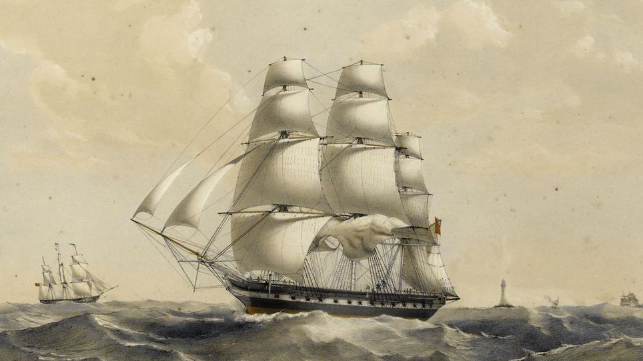
An American "Clipper" as advanced compared to the ships of Columbus as a modern jumbo jet is compared to a Wright Flyer

Commercial sailing technology would reach its zenith in the late nineteenth century  about the same time that steam engines would mature driving railroads and river boats to a point where commercial ship operators were prepared to use them at sea. Man had taken the air foil in vertical deployment about as far as it would go for commercial transport , and the air foil or sail had taken man around the world and back again many times over. 
 As mariners, ship wrights, naval architects and sail makers studied the function of sail , or the air foil in vertical deployment, it was very early on realized that the sail functions by channeling wind  towards the "Luff" which is a fairly narrow area near the mast. High pressure forms on the windward side of the sail and low pressure on the leeward or opposite side. Air moves from areas of high pressure to areas of low pressure. But the sail prevents the high pressure from infilling the low pressure area and a force known as "drive" is created. The mast is set in the hull which is set afloat in the low resistance medium of water. The "drive" exerted near the mast propels the boat forward. Notice that even the square sails on the clipper ship above can be rotated around the mast almost 180 degrees producing  at least some drive on all points of sail. In between the square sails are numerous triangular sails which are more efficient sailing closer to the wind. The sail plan was based on a law of averages but consistently produced excellent speeds on all points of sale.

Now every sailor who ever had to furl sail knew that an air foil if it got into a horizontal plane could exert a force  known as "Lift".  A wing is simply an airfoil deployed in the horizontal mode. Both lift and drive were very well understood by 1903. In 1903 the steamship was  dominant in maritime  commerce but there were still plenty of square riggers working when the Wright Brothers turned their airfoils into the horizontal position , attached power for a constant source of air flow for the creation of "lift". The Wright Brothers soon learned that control after lift off was the most difficult. At first they tried "wing warping" or changing the shape of the wing to control direction and altitude which was pretty much what sailors did with sails by use of the running rigging such as sheet lines.  Soon they opted to change only a portion of the wing's basic shape through the use of ailerons, stabilizers,  and the ship's rudder's cousin, the tail rudder. The world began to shrink at a much faster pace. Only 66 years after man's first heavier than air flight we landed on the moon. Truly sometimes a great notion is as simple as a mere shape and may come from someone as simple as an ancient sailor. 

I would tell my students after leading them through this exercise that mariners are part of an ancient and learned profession. Our profession's discoveries gave the world, the world; sewed it together and then gave it flight. Then I'd give them this little known fact. When the Wright Brothers made their first  flight at Kitty Hawk the hands that gave their flyer its initial push off were those of sailors of the nearby U.S. Life Saving Service Station, one of the ancestral organizations  of the U.S. Coast Guard. Once the ''Wright Flyers" became controllable in flight one of the first purchasers was the United States Navy. If you visit Dalghren Hall on the grounds of the Naval Academy you can see the Navy's original Wright Flyer: suspended from the ceiling.

Tuesday, October 9, 2018

Its Tough To Be A Christian, A Conservative, Or Even A Pragmatists These Days:

A REPLY TO AN ISLAMIC APOLOGIST
low-light photography of open book
Photo by Luke Palmer (PD)

"Quran (9:123) - "O you who believe! fight those of the unbelievers who are near to you and let them find in you hardness." 
Quran (17:16) - "And when We wish to destroy a town, We send Our commandment to the people of it who lead easy lives, but they transgress therein; thus the word proves true against it, so We destroy it with utter destruction.
"Hi Johnas Presbyter,
Your account, @JohnasPresbyter has been locked for violating the Twitter Rules."
"Specifically for:
Violating our rules against hateful conduct.
You may not promote violence against, threaten, or harass other people on the basis of race, ethnicity, national origin, sexual orientation, gender, gender identity, religious affiliation, age, disability, or serious disease."

Our observation of this Twitter rule in practice, simply add the words "unless your target is Christian, Conservative, Pragmatic, or a Realist"

Our First observation" We were threatened with loss of important access to the Internet for warning people about the violent tendencies of Islam in response to a Tweet. Is anything that is based on truth and designed to warn intended victims of sectarian launched violence a "Threat" or "Harrassment". We think we published a simple and needed warning and here we once again back it up from Islamic scripture. Islam intends exactly what we warned our readers about. 

 Consider: "Quran (8:12) "(Remember) when your Lord inspired the angels... "I will cast terror into the hearts of those who disbelieve. Therefore strike off their heads and strike off every fingertip of them" . Could any reasonable person interpret this as an admonition against violence? Indeed could it be anything other than an incitement to violence against non Muslims? 
Or ConsiderQuran (8:67) - "It is not for a Prophet that he should have prisoners of war until he had made a great slaughter in the land..And:

 Quran (9:38-39) - "O ye who believe! what is the matter with you, that, when ye are asked to go forth in the cause of Allah, ye cling heavily to the earth? Do ye prefer the life of this world to the Hereafter? But little is the comfort of this life, as compared with the Hereafter. Unless ye go forth, He will punish you with a grievous penalty, and put others in your place.This passage is widely interpreted in the Islamic world as threatening those Muslim who will not bear arms against non Muslims with eternal punishment in hell. Click on the Quran scriptural citation above to find more admonitions to constant violence against non Muslims or check out any of the very partial list below. 


What the Google PC Police Found Offensive: 
avatar
Johnas Presbyter
@JohnasPresbyter
MUZZIES BEING MUZZIES. The "Religion of Peace" is all about imposing peace on you by forcing your conversion and conformance or imposing the ultimate peace.....death. [...]
Twitter's threat: 
"Please note that repeated violations may lead to a permanent suspension of your account. Proceed to Twitter now to fix the issue with your account."

OUR CHALLENGE: TWITTER:  WHAT ISLAMIC MESSAGES URGING NON MUSLIMS TO SURRENDER TO "THE WAY OF ALLAH" OR URGING MUSLIMS AMONG US TO VIOLENCE AGAINST US  HAVE YOU REMOVED OR BLOCKED?

WHY IS ANYTHING THAT IS NOT POLITICALLY CORRECT PER THE LATEST FAR LEFT VIEW POINT "HATE SPEECH" BUT OUTRIGHT THREATENING CHRISTIANS IS NO PROBLEM FOR YOUR PC POLICE? WHY? WHY? What will you do if the 79% of us who are Christians were to boycott your services and petition the FCC to regulate you. News flash, would be Masters of the Universe; Cyber space, like the broadcast air waves is in the public domain. Operate in the public interest or see more regulation. 

WAKE UP AMERICA ! ISLAM IS EXACTLY AS WE PERCEIVE IT. THE PROOF IS IN THEIR OWN "SCARED SCRIPTURE" AND MUSLIMS PROVE IT DAY AFTER DAY AROUND THE WORLD IN COUNTLESS TERRORISTS INCIDENTS AND IN THE VIOLENCE THEY ADMINISTER WITHIN THE ISLAMIC STATES. CONTINUE TO ALLOW THE MAIN STREAM MEDIA AND NOW THE SELF APPOINTED LORDS OF THE INTERNET TO SUPPRESS ALL WARNINGS AND YOU WILL MEET THE FATE SPELLED OUT IN THE QURAN. BELOW IS A VERY PARTIAL LISTING OF QUOTES FROM THE QURAN URGING "GOOD" MUSLIMS TO VIOLENCE AGAINST "UNBELIVERS". Click on any of the Quran citations to find more. The list is seemingly endless:


Quran (21:44) - "...See they not that We gradually reduce the land (in their control) from its outlying borders? Is it then they who will win?"  Is this not why Muslims come here in such numbers? Is this not the instruction they follow in imposing their law in those small communities in the US where they have become the majority? 

Quran (2:216) - "Fighting is prescribed for you, and ye dislike it. But it is possible that ye dislike a thing which is good for you, and that ye love a thing which is bad for you. But Allah knoweth, and ye know not." 
Quran (3:56) - "As to those who reject faith, I will punish them with terrible agony in this world and in the Hereafter, nor will they have anyone to help.
Quran (3:151) - "Soon shall We cast terror into the hearts of the Unbelievers, for that they joined companions with Allah, for which He had sent no authority".
Quran (4:74) - "Let those fight in the way of Allah who sell the life of this world for the other. Whoso fighteth in the way of Allah, be he slain or be he victorious, on him We shall bestow a vast reward."
Quran (4:76) - "Those who believe fight in the cause of Allah…"
Quran (4:89) - "They but wish that ye should reject Faith, as they do, and thus be on the same footing (as they): But take not friends from their ranks until they flee in the way of Allah (From what is forbidden). But if they turn renegades, seize them and slay them wherever ye find them; and (in any case) take no friends or helpers from their ranks."
Quran (4:95) - "Not equal are those of the believers who sit (at home), except those who are disabled (by injury or are blind or lame, etc.), and those who strive hard and fight in the Cause of Allah with their wealth and their lives. Allah has preferred in grades those who strive hard and fight with their wealth and their lives above those who sit (at home).Unto each, Allah has promised good (Paradise), but Allah has preferred those who strive hard and fight, above those who sit (at home) by a huge reward " This passage criticizes "peaceful" Muslims who do not join in the violence, letting them know that they are less worthy in Allah's eyes. It also demolishes the modern myth that "Jihad" doesn't mean holy war in the Quran, but rather a spiritual struggle. Not only is this Arabic word (mujahiduna) used in this passage, but it is clearly not referring to anything spiritual, since the physically disabled are given exemption. (The Hadith reveals the context of the passage to be in response to a blind man's protest that he is unable to engage in Jihad, which would not make sense if it meant an internal struggle).
Quran (4:101) - "And when you (Muslims) travel in the land, there is no sin on you if you shorten your Salat (prayer) if you fear that the disbelievers may attack you, verily, the disbelievers are ever unto you open enemies." 
Quran (4:104) - "And be not weak hearted in pursuit of the enemy; if you suffer pain, then surely they (too) suffer pain as you suffer pain..." Is pursuing an injured and retreating enemy really an act of self-defense?
Quran (5:33) - "The punishment of those who wage war against Allah and His messenger and strive to make mischief in the land is only this, that they should be murdered or crucified or their hands and their feet should be cut off on opposite sides or they should be imprisoned; this shall be as a disgrace for them in this world, and in the hereafter they shall have a grievous chastisement" 
Quran (8:39) - "And fight with them until there is no more fitna (disorder, unbelief) and religion is all for Allah
Quran (8:57) - "If thou comest on them in the war, deal with them so as to strike fear in those who are behind them, that haply they may remember." 
Quran (8:67) - "It is not for a Prophet that he should have prisoners of war until he had made a great slaughter in the land..."
Quran (8:59-60) - "And let not those who disbelieve suppose that they can outstrip (Allah's Purpose). Lo! they cannot escape. Make ready for them all thou canst of (armed) force and of horses tethered, that thereby ye may dismay the enemy of Allah and your enemy.
Quran (9:5) - "So when the sacred months have passed away, then slay the idolaters wherever you find them, and take them captive and besiege them and lie in wait for them in every ambush, then if they repent and keep up prayer and pay the poor-rate, leave their way free to them." 
Quran (9:14) - "Fight against them so that Allah will punish them by your hands and disgrace them and give you victory over them and heal the breasts of a believing people."
Quran (9:29) - "Fight those who believe not in Allah nor the Last Day, nor hold that forbidden which hath been forbidden by Allah and His Messenger, nor acknowledge the religion of Truth, (even if they are) of the People of the Book, until they pay the Jizya with willing submission, and feel themselves subdued."
Quran (9:30) - "And the Jews say: Ezra is the son of Allah; and the Christians say: The Messiah is the son of Allah; these are the words of their mouths; they imitate the saying of those who disbelieved before; may Allah destroy them; how they are turned away!" 
Quran (9:111) - "Allah hath purchased of the believers their persons and their goods; for theirs (in return) is the garden (of Paradise): they fight in His cause, and slay and are slain: a promise binding on Him in truth, through the Law, the Gospel, and the Quran: and who is more faithful to his covenant than Allah? then rejoice in the bargain which ye have concluded: that is the achievement supreme." 

Twitter, Google, Facebook in our humble opinion and based on our own bitter experience these companies are not operating "in the public interest". We only ask for the same freedom of expression they give to the Muslims, Communists, and Globalists Socialist. Did you ever wonder why our status as an Amazon Portal ended? Do you ever wonder why no advertisers appear in our posts? Have you , like us ever wondered just how far these "masters of Cyber Space" will go to silence even a rare occasional voice of common sense?  Have you ever noticed that we are primarily an encyclopedic site that deals in maritime matters of all sorts? Why do we occasionally post on Islamic History or current Islamic events? We explained that years ago. Activities in the Islamic World account for much our USN aircraft carrier task force deployments. Islam fails upon the any serious scrutiny by any critical thinker as a "religion of peace". Unless you find the thought of death at the hands of enforcers of a religious orthodoxy "peaceful". To speak that truth will ultimately get the speaker bounced from the public forum.  0ver 600,000 of you have visited our site. How many will stand up for us when the PC police come to run us out of cyber space? 


Monday, October 8, 2018

COLUMBUS DAY:COLUMBUS IS STILL WORTH STUDYING

ESSAY NUMBER 12

CHAPTER 4 THE PERILS OF FIRST CONTACT
WHY WE DON'T WANT TO REPEAT THE COLOMBIAN EXCHANGE ON A COSMIC SCALE 


LESSONS FROM THE AGE OF EUROPEAN MARINE EXPLORATION FOR THE SPACE AGE.

No matter what propulsion system we may be using at the time, inevitably we will encounter extra terrestrial life. The first time it might be microbes, which in fact might be the most dangerous encounter we will experience. We'll discuss the odds, later but we have to be prepared for the possibility of encountering other civilizations . Again our ocean planet's history can provide some insight on how we should prepare to handle this contingency and how to avoid the mistakes of our past.


WHEN COLUMBUS MET GUACANAGARI  The Perils Of First Contact, A Case Study


 The first landfall of Columbus in the New World is a subject of considerable academic debate. Wherever the landing actually took place, Columbus called the island "San Salvador". For many years historians generally believed this to be an island known as "Wattling Island"in the Bahamas which later was renamed "San Salvador". At least nine other islands have been seriously examined as possibilities. The most often discussed seems to be Samana Cay. There has been debate over the issue for years and strong cases have been made for other islands as the first landfall of Columbus. Some of the most scholarly debate in terms of forensic navigation have been carried in the pages of the Naval Institute PROCEEDINGS and NATIONAL GEOGRAPHIC. However, the where of the first landfall of Columbus is not as important for an examination of the lessons of the first contact.


 The first lesson to be derived from the first voyage of Columbus is the definition of "first contact". Is "first contact" as a matter of gravest concern, the first contact between emissaries of an alien culture and the first inhabitants met? Or is "first contact" the first meeting between the emissaries and the first officials of the culture visited. The first contact between Columbus and native Americans made little impression on the culture of San Salvador, an apparent rural back water  but provided Columbus with some vital intelligence. His next contact with a real Chief of numerous villages Guacanagari would set the course for European /Native American relations for centuries. There is a high probability when exploring unknown areas that actual first contact will be unplanned. Let us examine the first days of Columbus in the New World and ask our selves what there is to learn from the Columbus experience if initial contact in our own explorations will be with non official persons. Let us also look for lessons for that first contact with officials;  what we might learn that would allow us to be better prepared in the event of an encounter with another civilization in outer space.


 Columbus became convinced that he was near land on October 11, 1492. Land birds were seen from his ships and a carved wooden object had been recovered from the sea. However by sundown nothing else had been seen. At 2200 (10 PM) Columbus and crewman Pedro Guttierrez and Rodrigo Sanchez saw a light to the Southwest. The Pinta set course for the light. At 0200 (2 AM) October 12, 1492 crewman Rudrigo de Triana sighted land. Columbus fell to his knees in gratitude to God. To quell a potential mutiny Columbus had agreed to sail westward for only three days more on October 10, 1492. As dawn broke Columbus and his men saw a small green Island. A small boat was  launched and the crew with Columbus embarked pulled for shore. While still offshore Columbus observed a group of people come out of the forest. First contact was about to happen. The people came down to the beach and stood looking at the approaching boat. Columbus dressed in his finest for the occasion buckled on his sword and armor when he saw the people on the beach. The sailors were also armed.


 When the boat landed Columbus and the sailors disembarked. The people from the forest stood a little distance off while Columbus unfurled the Spanish flag and proclaimed himself viceroy of the island he named "San Salvador". The people from the forest continued to stand a little ways off. Gripping , but not brandishing his sword, Columbus approached. The people proved friendly and curious. They accepted a few trinkets with apparent pleasure and ran off. The crew set out exploring the island. The next day the islanders returned in great numbers. Columbus noticed that some of the natives wore ornaments of gold. Communicating mostly through sign language Columbus discovered that the source of the gold was a large island nearby to the south east. Columbus set sail for the south east where he found another island and more friendly inhabitants, some with gold ornaments. Once again Columbus was told the gold producing island was elsewhere.  Again Columbus set sail. Columbus island hopped for two weeks in the Bahamas meeting people on each island and eventually ended up off the coast of the island that we now call Cuba.


 On November 21, 1492 a strong wind separated the PINTA from the SANTA MARIA and the NINA. THE SANTA MARIA and the NINA headed east and arrived off the island of Hispaniola. Here Columbus met the first real native "official" since landing on "San Salvador", a local chief named Guacanagari. Columbus was impressed with Guacanagari who arrived with flourishes and the entourage Columbus thought worthy of a minor Oriental prince; but displayed a friendly , outgoing nature, apparently tempered with great humility. Guacanagari, a chief of the peaceful Tainos in turn was impressed with Columbus. Guacanagari feared the cannibalistic Caribs, Columbus looked like a potentially powerful ally. In turn Columbus would shortly be in need of Guacangari's assistance.


 On Christmas day 1492 the SANTA MARIA fetched aground on a reef. The ship did not sink but could not be re-floated. She was so badly damaged that it was clear that the SANTA MARIA would never return to Spain. Now Columbus really needed Guacanagari. Guacanagari provided men to help offload the  SANTA MARIA" and strip her of useful fittings. The NINA was too small to carry both crews back to Spain. Columbus would have to leave some of the men with Guacanagari.Columbus had grown to trust Guacanagari and Guacanagari had apparently developed a genuine interest in and apparent affection for the Europeans.


 There can be little doubt that the civilized behavior,apparent command of resources, obvious authority, and the gift of a mask made partially of gold by Guacanagari helped convince Columbus that he was on the outskirts of the Orient. It would be to Guacanagari that Columbus would entrust nearly a third of his crew, and to Guacanagari that Columbus would return on his second voyage. The crew must have also been impressed with the Tianos people, Guacanagari, and the climate and terrain of the Bahamas because many crewmen volunteered, even begged to remain. Thirty nine were chosen from an abundance of volunteers. Diego de Arana , the Master at Arms was left in command. With the help of the Tianos the crew built a fort from the remains of the ship and stored it with provisions and weapons. Since the ship wreck had occurred on Christmas Columbus called the fort "la Navidad". After a farewell banquet with Guacanagari Columbus departed for Spain during the first week of the new year 1493.


 Shortly after the start of the return voyage the Nina sighted the Pinta. They would separate again in a storm before reaching Spain. The story of Columbus's return voyage from his first visit to the New World, the rivalry between Columbus and the Captain of the PINTA , the intrigue at court after the return of the NINA and  PINTA could fill a book. But these details detract from the examination of the events surrounding Columbus and Guacanagari. Consequently we will leave the details of the return voyage and organization of the second voyage back to Guacanagari's island to others and cut to the return of Columbus to "La Navidad".


 The sovereigns of Spain authorized a second voyage and issued formal instructions. These formal instructions included a call for the conversion of the natives to Christianity but stipulated that the natives be treated "well and honorably". Communications would be facilitated on this second voyage by the presence of former captive "Indians" who had been baptized, learned Spanish, and could act as interpreters. This second expedition would consist of seventeen vessels and 1,200 to 1500 men. On September 25, 1493 Columbus left the port of Cadiz to great fanfare for a return in force to La Navidad. Before reaching La Navidad Columbus landed on an island he called Guadeloupe. This turned out to be the home island of the free ranging and raiding cannibal Caribs so feared by Guacanagari. No violence ensued because most of the warriors were gone on a raiding party off island. The remaining Caribs, mostly women, old men and a few captives explained this mostly by hand gestures. The Europeans took twelve young women and two boys who had been captives of the Caribs with them as they departed the island.


 After leaving Guadeloupe the fleet sailed along the south coast of Puerto Rico to the north shore of Hispaniola. Columbus looked forward to seeing La Navidad and the progress he hoped had been made there in the interval since his departure. He looked forward to seeing Guacanagari who he was certain would impress his fellow adventurers. But when they anchored off the island, there was no answer to their salute. Indeed there was little sign of life. Shore parties found bodies near the remains of the fort which had been burned. Shore parties found bodies near the remains of the fort which had been burned,the first were badly decomposed and could not be identified. Two however were bearded and surely European,  What would come to be known as America , had lost its first European colony. Guacanagari sent regrets to Columbus by envoy blaming the massacre on the Caribs. Guacanagari claimed that he had tried to defend the Spaniards and was wounded as a result. Columbus and several men went to visit Guacangari but noticed that he bore no scars. Little by little Columbus learned the truth.  The men he left behind had behaved badly, lusting after gold and taking "Indian" women. The Tianos defended and avenged themselves. The first European settlement in the New World came to a bitter end as a bloody massacre. The trust between the Tianos and the Europeans was broken. Though immediate relations between the new landing party and Guacanagari's Tianos were cordial on the surface, storm clouds were gathering.

--------------------------------------------------------------------------------------------------------

WHY DID COLUMBUS PERSIST IN HIS BELIEF THAT HE HAD REACHED THE ORIENT? AN EXAMINATION OF HIS FOURTH VOYAGE

ESSAY NUMBER 15 


                                                       SVN 24, a GPS IIA satellite similar to the one in this image, is currently on the move to provide enhanced GPS coverage to users worldwide.  The satellite is expected to arrive in its new location within the GPS constellation sometime in January 2011. (Public domain image courtesy of http://pnt.gov/public/images/.)                                                                            Public domain image courtesy of http://pnt.gov/public/images/.

LESSONS FROM THE AGE OF EUROPEAN MARINE EXPLORATION FOR THE SPACE AGE.

DID COLUMBUS CLEAR CUSTOMS?


 Most historians seem a bit perplexed at Columbus's persistent belief that he had reached the Orient. Many credit him with more than a typical share of stubbornness bordering on obsession. In the popular mind Columbus arrives in the Bahamas meets "Savages", encounters no riches associated with the Orient, and inexplicably persists in his belief that he has reached the Orient. But this was simply not the case.


 First as we learned in our description of the landing of Columbus as described in preceding pages he didn't find the "Indians" of his "San Salvador" to be "savages" at all, but "peasants". He fully expected to find peasants in Oriental society as he knew them in his own and the Oriental version was described in the account of the travels of Marco Polo with which he was familiar. Moreover these very first peasants displayed small items of gold. When Columbus met Guancanagari he found a society of perhaps some thirty thousand souls with significant organization. His description of his first sight of Guacanagari indicates the trappings and entourage that a European who had never visited the Orient might associate with a minor Royal of a rural part of an Oriental kingdom. With Guacanagari Columbus received more gold and some previously unknown spices, exactly what he anticipated finding in the Orient. But the ship wreck of the SANTA MARIA  forced an early return. Columbus was quite well aware that he had but sampled a very few of some offshore islands, that he had good reason to believe were off the Asian mainland. Historians agree that Columbus believed the circumference of the earth to be  less than we now know it is, plus he probably believed the land mass of Asia was much larger than what it is, and he had no real way of measuring longitude . When these facts are considered along with an unjaundiced view of exactly what Columbus saw on his first voyage it seems quite reasonable that he believed he had reached the Orient on his first voyage.

 His second and third voyages involved mostly establishing a base of operations on Hispaniola and a gold mining operation. His opportunities to explore freely were minimal. He eventually did visit the north coast of South America. He did come to understand that South America was a previously unknown continent far to the south of the Asian land mass. In more northerly latitudes he still expected to find what we now call China and Japan. On his fourth voyage he would actually reach the Caribbean coast of Central America and encounter coastal Mayans, What he would see could only further convince a European of his day that he had reached the Orient.

 The Mayan coast lands were long and Columbus must have suspected that he was coasting along a mainland. He could not know how narrow parts of that mainland were or the great Pacific Ocean, an ocean that his world dimensions had no room for, was beyond the distantly glimpsed mountains to the west. But what was of far more significance was that Columbus now encountered a coast with coast wise trading vessels the size of galleys that he was familiar with in his own Mediterranean world. He encountered a coast with ports, some of which had breakwaters, officials, and signal beacons. The vessels were huge canoes with shelters amidships of tightly woven palm leaves. The canoes had large crews and significant weather protected cargo capacities. They were in the charge of well dressed merchants who often had their families along. These trading, coastal large canoes were engaged in regular and organized trade. The ports had official buildings of impressive size made of stone and displayed a strange but advanced architecture. Columbus had come face to face with what could be described as the Mayan Merchant Marine.
 Columbus first encountered the Mayan coast wise traders in 1502 near what is now referred to as the Bay Islands of Honduras. In his log he noted:


   "There arrived a canoe full of Indians , as long as a galley and eight feet wide. It was loaded with merchandise from the west, almost certainly from the land of Yucatan"

 Columbus described a thatched palm shelter midships in the craft sheltering women and children as well as merchandise from both rain and sea. The women and children seemed to be family of the presiding merchants. The crew consisted of nearly twenty five men. Trade goods consisted of high quality cotton cloth of intricate design and many colors, flint bladed tools and weapons, swords carved of very hard wood and a variety of food items. This first encounter was not untypical of a variety of craft that Columbus would observe on his fourth voyage, in fact this particular canoe was a bit on the modest size. Some historical accounts describe Mayan vessels capable of carrying forty to fifty people plus large amounts of trade goods. Most Mayan traders followed the coast line using natural features, shrines and towers as short range aids to navigation. However some Mayan navigators ventured offshore. The Mayans had reached and colonized such offshore islands as Cozumel, the Belize Cays and Bay Islands by 600 to 900 AD.

 As the Mayan culture evolved some seaside villages developed into real ports of call and trading centers. One such example was the town of Cerros on Chetumal Bay in what is now northern Belize. This town was located at the confluence of the mouths of the New and Hondo rivers. The port connected the coastal and offshore island trade with the inland regions of the Mayan empire reachable by the two rivers. The Mayan maritime trade made use of many natural harbors but also made artificial improvements where needed. On the northern coast of Yucatan on the island of Cerritos the ruins of docks, piers, and a 1,000 foot seawall can be found. The maritime trade infrastructure of the Maya spread across the whole coastline of Mexico to what is now called Panama and extended inland at every navigable river. Between 900 and 1520 AD this Meso American maritime trade flourished and became sort of international in scope involving not only the seafaring Mayans but also seafaring Aztecs and other peoples. By the time of first contact much of this trade had come to be controlled by wealthy nobles tied to each other through marriage and formal alliances and dominating the economies of these widely spaced coastal communities. This system collapsed shortly after the Spanish conquest and has been largely forgotten. But this was the system that Columbus saw on his fourth voyage. On that voyage he saw people of apparently Asiatic racial stock and of a high order of civilization engaged in an extensive and organized maritime trade from real port cities. Why would he think he was anywhere else but Asia?

Any review of primary sources of the early period of European contact with American natives reveals a "New World" populated by both tribal peoples  and what can only be described as "nation states". Columbus sailed into a World of inter tribal and "international" relationships and conflicts. He was first seen by the first officials he encountered as a powerful potential ally against a truly savage tribe harassing a more civilized tribe enjoying no advantage in weapons, tactics, or technology. Columbus and subsequent Spaniards enjoyed a narrow but critical advantage in weapons and transport technology. They were also possessed of a moral code that rendered parts of the preexisting order of the "New World" offensive. Instead of learning and fitting into the existing order the Spaniards would cite certain practices of the preexisting order as justification for conquest, made possible by their narrow technological advantages.  They also unwittingly aided and abetted in conquest by microorganisms. The collision between the old and new worlds at the subhuman level will be the subject of other discussions. The purpose of this discussion is to examine how one view of world order was totally eclipsed by another when two radically different cultures collided after years of separation by a vast previously uncrossable ocean.

 Columbus and those who followed in his wake entered a world of alliances, conflicts, trade, communications, and some long established rules of order. The Europeans would exhibit no consideration of any of the established rules of order, would exploit conflicts and alliances to their advantage, and manipulate trade to their advantage at every opportunity. In the process the Europeans would struggle with each other and eventually evolve a highly organized body of international law.

 As we push out into space, particularly space beyond our own solar system we may be entering a realm where a preexisting legal order may be operative, or operative in certain regions only, or non existent. we may bring important legal ideas to the forum, or our ideas may be viewed as valueless as the Europeans viewed the preexisting order of the Indian nations. For all we know our undisturbed evolution to date may be the result of an existing interplanetary legal order. Before we launch into space beyond our solar system we need to consider the possibilities of interplanetary law. We will probably have to guess at it , but our own experience in the evolution of international law, particularly maritime international law should give us some valuable insights. Unlike the Europeans during the age of exploration we had better not assume we enter the region with any superior codes or the ability or any moral right to impose such. A review of our own maritime international law  could provide us with some insights into any preexisting interplanetary order.

Tuesday, October 2, 2018

Armed Merchant Ships As Force Multipliers In The 21st Century

GREAT ARTICLE IN THE MARITIME EXECUTIVE

alt
The well-armed East Indiaman Madagascar (William Foster / UK National Maritime Museum) (lifted from linked post at THE MARITIME EXECUTIVE


"Given the current size of the fleet and the potential need for high endurance escorts for the Navy’s replenishment force, a force of 21st century cargo ships outfitted with frigate-level armament to escort themselves makes good financial and operational sense." Steve Wills writing in A FIGHTING MERCHANT SHIP FOR THE TWENTY FIRST CENTURY In THE MARITIME EXECUTIVE.

 Steve Will has written a thought provoking article in the MARITIME EXECUTIVE proposing the arming of some of the Navy's Military Sealift Command ships. This could be more easily done than one might think at first thought. Modern Infantry have shoulder mounted anti armour and anti aircraft weapons that could easily fit in a single shipping container. These could do serious damage to smaller naval attackers or very small flights of attacking naval aircraft. There is some smaller antisubmarine weaponry around; and even such a light load out as we suggest here could make a transport traveling alone quite formidable against many Third World naval attackers. But Will goes beyond that and suggests transports armed to near the level of naval frigates. He provides details right down to the amount of square footage left for cargo space after the installation of such armament .The remaining cargo space is impressive. Transports capable of self defense would free war ships from escort duty and make them available for the fight. There are legal and cultural hurdles to over come and Will addresses these in detail. This is corking good read found at:   https://www.maritime-executive.com/editorials/a-fighting-merchant-ship-for-the-21st-century?platform=hootsuite We recommend the MARITIME EXECUTIVE to our visitors as part of any maritime professional's weekly if not daily professional reading. We always maintain a link to the publication in our NEWS SERVICE

Thursday, September 27, 2018

SEPTEMBER 27, 1942 THE COAST GUARD'S ULTIMATE "YOU HAVE TO GO OUT, YOU DON'T HAVE TO COME BACK" STORY


Image result for Images of Coast Guardsman Douglas Munroe
SIGNAL MAN FIRST CLASS (DEPICTED WHEN HE WAS THIRD CLASS) DOUGLAS MUNROE
Photo USCG


It has now been 76 years since that day . It was on a Sunday the 27th of September 1942  that the Coast Guard saw one of its "finest hours." Coast Guardsmen "go out" into the storm or the fire storm, to punish our enemies and seafaring law breakers, or to save the imperiled. Its a job full of risk. "You have to go out, you don't have to come back". That is one of the oldest sayings in the Coast Guard and was immortalized in a recent Disney film called "FINEST HOURS" It was a Sunday, 27 Sept 1942, 76 years ago that the Coast Guard experienced one of its finest hours involving both missions, "to punish or to save". The place was Guadalcanal in the Pacific. 

 U.S. Coast Guard Signalman First Class Douglas Munro was supervising petty officer of a detachment of ten Higgins boats which landed U.S. Marines on the beach. He landed the marines safely and returned with his flotilla of boats to the mother ship. Once aboard he  learned that conditions ashore had greatly deteriorated for the marines. It had become  necessary to immediately extract the nearly 500 Marines. Douglas Munro volunteered for the mission and brought his little flotilla to shore under heavy enemy fire. The extraction underfire proceeded. However when most of the marines were in the boats, the positions of the last men ashore became more exposed to heavy fire.  Munro realized the danger to his targets of rescue. Without hesitation he placed himself and his boats so that they would serve as cover for the last men to leave, his boat closest to the enemy machine gun nest. Among the Marines saved that Sunday was Lieutenant Colonel Lewis B. "Chesty" Puller, USMC, in command of 1st Battalion, 7th Marines. During the final phase of the extraction under fire Munro was fatally wounded. His last words were : "Did they get off?"

Douglas Munroe gave his life in the successful extraction under fire and was posthumously awarded the Medal of Honor, to date the only Coast Guardsman to receive the decoration under its modern title. Prior to the formation of the Coast Guard , its predecessor organization the "Revenue Marine" is listed as having received 14 "Gold Congressional Medals of Honor" for combat related performance. These were not the modern award but specially congressionally authorized gold medals. After the battle of Manila Bay the Navy objected to Revenue Mariners receiving certin military awards calling them "civilians". The Revenue Marine was always subject to the call to arms under the Navy in time of war and had participated in every US war since the War of 1812. After the reformation of the service under the name "Coast Guard" in the second decade of the 20th century, the law reflected and described the service as an "Armed Service" and restated its obligations to the Navy. The one constant since the founding of the Revenue Marine in 1790? "You have to go out.....you don't have to come back". Douglas Munroe lived the creed and while he lost his life he lives forever in Coast Guard memory.