 |
| GLOBAL VIEW FROM NASA COURTESY CIA WORLD FACTBOOK ARCTIC ICE AT ITS MINIMUM EXTENT IN 2005 |
The Coast Guard's efforts at establishing a "persistent presence" in the High Arctic Ocean and on the North Slope of Alaska has been bogged down by major financial and logistic hurdles. Of course the first hurdle is the fact that while Congress demands such a presence; and rightfully so considering Russia's increasing presence and recent territorial claims almost to the boundary of our territorial sea, they haven't fully budgeted such a presence. Nothing unusual there, the Congress has never been known for fully budgeting all Coast Guard missions and especially so in recent times.
" The Coast Guard has been trying to establish a persistent presence on the North Slope for a few years now using "
forward basing" concepts, crew rotations, seasonal vessel presence and other tried and true ideas from earlier "isolated duty" developments.
In the High Arctic forward basing is proving terribly expensive, especially when not specifically budgeted for.
However if the Coast Guard would start to think in terms of a constabulary force in the High Arctic a lot of the forward basing expenses, crew rotational expenses, could be reduced greatly. This would result in more extensive and persistent, and obvious, year round presence and service achieved. Historically, the North Slope of Alaska has been permanently inhabited by organized human society since at least 900 AD, probably longer. There is a native educated population and work force available for many Coast Guard civil missions that can be performed by civil servants.
The North Slope is "sparsely inhabited" but far from uninhabited, there is a resident work force that could man Coast Guard civil mission facilities with training.
 Photo USCG
Regular Coast Guard Forces on the North Slope are only visitors and the logistic train is long and expensive. A native work force for most civil missions of the Coast Guard would reduce the logistic train, increase services and extend availability and persistence while lowering costs.
THE CONCEPT OF A CONSTABULARY FORCE
The concept of a constabulary force is not new to the High Arctic reaches, just to American thinking. The Canadian Mounted Police utilize a constabulary corps all over the remotest regions of Canada. The RCMP constables are local officers who may leave the area of their assignment for periodic training but almost never on new permanent assignment. These RCMP constables are recruited from local people from long established families in the areas. The "constables" are quite happy living in these remote locations and quite happy to have a real career opportunity at home. The concept actually isn't alien to the Coast Guard now or historically. During the days of one of the Coast Guard predecessor organizations the U.S.Life Saving Service (USLSS) local rescue stations were manned by civil service local boatmen. The station Captain may have been drawn at times from a national roster of uniformed members but most often was local and there for the long term. Another Coast Guard predecessor agency was the U. S. Light House Service (USLHS). Some primary seacoast lights were literally tended by as many as two generations of civil service "keepers" drawn from locals who worked the light and lived on the light's grounds in the "keeper's quarters" sometimes passing the arrangement down to a son or daughter.
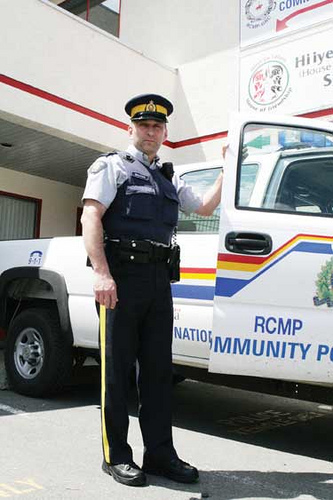

RCMP DAILY UNIFORM U.S.Life Saving Service Crew Photo USCG
Today the Coast Guard's repository of local knowledge resides with its uniformed military reserve and uniformed but civilian volunteer Auxiliary. Unfortunately, the Coast Guard doesn't think of these constabulary forces as such very often, rather they are seen by modern Coast Guard administrators as "force multipliers" to be called out to augment the presence of the regular force. In fact though, there are even today, situations where these are true constabulary forces, the main force on scene with the regular forces in the supportive role. For example there are large inland lakes on state borders where an "Auxiliary Station" is the only real persistent Cost Guard presence. On the Great Lakes there are a number of life saving stations in the "Summer Stock" program that are only fully manned in summer by activated military reserve members. Many of the Coast Guard's Vessel Traffic Centers are manned in large part by local civil servants.
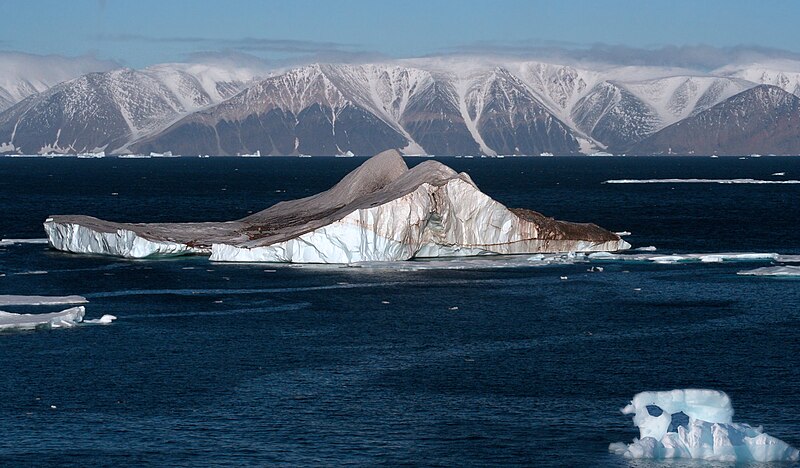 The High Arctic is a tough place to live for man or beast but people have been living there for thousands of years. By focusing on building a native civil service corps and volunteer Auxiliary and reserve members there will be less need for expensive crew rotations and logistic support of regular Coast Guard personnel. Not all of it is wilderness, case in point: Barrow , Alaska
BARROW IN SUMMER
THERE IS EXISTING TRANSPORTATION , AVIATION, COMMUNICATIONS, MEDICAL SERVICES, AND RESIDENTIAL / TEMPORARY LODGING INFRASTRUCTURE IN PLACE
This photo of Top of the World Hotel is courtesy of TripAdvisor. An updated version was built on a different site completed by fall of 2014. The building, if available for sale would be an easy conversion to a Coast Guard operations center and barracks at far less than new building costs in Barrow.
In the High Arctic, especially at Barrow there is actually a resident work force large enough to provide ample recruiting populations for many Coast Guard civil missions and military support missions as career, local civil servants, Auxiliary volunteers, and in some cases, Coast Guard military reserve members. The Arctic region natives make up the majority of residents in Barrow and many of the non native population are intermarried so that in Barrow, on the very shores of the Arctic Ocean there is a population of thousands with deep roots there who expect to raise children there in the presence of the children's grandparents. Make no mistake about it, Barrow is a cold and forbidding place to most anyone from the rest of the United States, but it is home to thousands of people.
Barrow is no Arctic boom town. Only incorporated as an Alaskan city in the late 1950s it none the less has been a human population center on the Arctic shore since at least 900 AD. While the Coast Guard would definitely have to rotate outsiders in and out for relatively short tours of duty the Barrow and North Slope Borough contains enough qualified workers with a high school diploma through Associate's Degrees to fill most of the civil service jobs that it would take to support a communications station, possible future Vessel Traffic Center, Aids to Navigation Support facility, much of the aviation support for a forward seasonal air base and/ or year round UAV operation. Barrow has 4,429 permanent residents of which 61 percent are Inupiat Eskimo. Many other residents are related to the Inupiat people through marriage, it is a fact that the 4,429 residents of Barrow are not easily amendable to relocation. However many of the residents of smaller villages and towns in the
North Slope Borough would relocate to Barrow for a good job. The total population of the North Slope Borough is about 9,400. Because Barrow is the administrative center of the North Slope Borough it contains many of the features one might expect to see in a county seat with a population of 50,000 including two hotels, a hospital, public schools through high school and a community college, a public library,a Presbyterian church since 1898, a U.S. Post Office, a number of restaurants, a supermarket, dry cleaners, specialty stores, and a municipal airport with regularly scheduled regional airline service. There are not a lot of people in the North Slope Borough but those who live there were most often born there and like it just fine. Barrow is their capitol and they take great civic pride in it.
THERE IS AVAILABLE A SIZABLE EDUCATED LOCAL WORK FORCE FROM WHICH TO RECRUIT A CONSTABULARY CIVIL SERVICE FORCE, AUXILIARY AND RESERVE VOLUNTEERS.
In the North Slope communities about 85% of the population over the age of 25 has a high school education or better. There are 639 military veterans in the population. The annual, non seasonally adjusted unemployment rate for 2012 was 4.5%. According to the 2010 census there were 957 members of the North Slope Work Force unemployed. It would be a fair assumption that of the 957 unemployed members of the work force in 2010 as many as 813 would have been in possession of a high school diploma or higher level of general educational achievement. In 2010 1,275 members of the North Slope Borough work force self described themselves as "under employed". To start building a constabulary force the Coast Guard would probably only need a dozen or so initial employees all of which would probably require extensive training. Few would need an education beyond high school to succeed at the training. The unemployed and underemployed segments of the work force appear more than adequate to recruit an initial start up work force from. The youth of the region appear to want to stay in the area and new potential employees will be entering the work force annually. If the Coast Guard were to partner with the local community college the training requirements for future new hires could be reduced and recruitment to keep pace with Constabulary force growth would be virtually assured.
RECENT ATTEMPTS AT ESTABLISHING A "FORWARD BASE" PRODUCED EVIDENCE OF SOME SERIOUSLY EXPENSIVE LOGISTIC REQUIREMENTS TO THE TRADITIONAL COAST GUARD FORWARD BASE / ISOLATED DUTY ORGANIZATIONAL MODELS.
U.S. Coast Guard
ARCTIC STRATEGY
MAY 2013
The present Coast Guard Arctic Strategy Implementation Plan (2015) (linked to above) calls for a ten year "Planning Horizon". This plan assumes "
Current demand signal for Coast Guard services in the Arctic will remain at current levels, or slightly increase." We think the militarilization of the High Arctic region by Russia warrants a more immediate response that is not just based on US High Arctic citizen demand for traditional Coast Guard services, but responds to the national security need to project a more vigorous military presence in the region that. none the less. is not provocative in nature. A substantial increase in Coast Guard radio traffic, and year round aerial operations , even if the winter ops are largely by drone has deterrent value. While the Coast Guard is not a threatening military organization, it is historically closely tied to the U.S. Navy and an enabling force for the U.S. Navy. A strong Coast Guard presence signals that a U.S. Navy presence deployed to the area will have a welcoming supporting force in being. The present Coast Guard plan calls for many of the traditional Coast Guard approaches to "isolated duty". We have observed that some of these traditional plans have not worked as hoped for in the High Arctic environment, onecase being experiences with seasonal helicopter deployment.
During Coast Guard
operation Arctic Shield the Coast Guard operated two H-60 helicopters for a portion of the summer season out of Barrow. Barrow has a commercial air port and it was thought that operating two of the helicopters would be greatly facilitated by having a commercial air port to operate out of. However the only available rental hangers were a tight fit and the rental was about $60,000 each per month. During the Forward basing test 25 air crewmen were rotated in an out for three week tours. The North Slope is shaping up as the single most expensive place where the Coast Guard has ever been mandated to expand into with its full range of services. By basing the Coast Guard presence in the region on a largely constabulary force based model a lot of the seasonal and even shorter term rotational posting, and hardship isolated duty posting could be greatly reduced or eliminated. The Constabulary approach increases Coast Guard institutional local knowledge, and extends many services that might have been seasonal into year round services. Here are some potential examples of constabulary approaches to a variety of Coast Guard missions that will have to performed in the area.
Marine and Maritime Aerial Communications. The Coast Guard could probably partner with the North Slope Police for a small space in the police station for an aviation radio, single side band, and Vhf marine radio transceivers. Four local high school grads could be hired as civilian radio operator trainees (suggested GS 5 level) and be sent for several months to voice radio operations training to the Coast Guard Auxiliary voice radio operator syllabus. On return the trainees would be promoted to civilian voice radio operators and would man "Coast Guard Auxiliary Radio Station Barrow" in the police station as close to a 24/7 basis as possible. They would also be expected to recruit and train some Auxiliary volunteers to help bring the Auxiliary radio station up to constant 24/7 operations. The newly qualified radio operators would be promoted to GS-7. One of the new operators would be promoted to GS 9 and made "station supervisor" with responsibility for scheduling, Auxiliary recruitment , over time control, maintenance etc. The Auxiliary radio station would temporarily be dependent on the police for communications outside of the marine and aviation bands with the outside world. The Auxiliary radio station would be serviced by the same technicians servicing the police station communications equipment.
At the same time that the radio operator trainees are hired someone local with a business administration back ground should be hired and sent to training with Coast Guard yeomen and civilian administrators in civil service pay and benefit management, as well as property management. This person should probably be recruited at the GS 8 level and promoted to GS 10 on completion of training. Returned to barrow this person's initial duties would be to see to the wage and benefit administration of the radio operators and processing of any expense claims by Auxiliary volunteers. This position should be eligible for eventual promotion all the way to GS 14 as the civil service , Auxiliary volunteer, military reservists constabulary work force grows. The Constabulary work force is going to need a Constabulary personnel administrator to assure the pay checks show up on time. The initial radio operators provide a nucleus of trainable existing civil servants around which an eventual regional communications station and or vessel traffic service might be grown.
Aids to Navigation
The constabulary model for this mission is based on the old Light House keeper model. The mission kick off starts with the recruitment of a single aids to navigation technician who will probably have to be trained out of area but must be a resident of the area with an intention to stay. His or her first task would be to research all private aids to navigation in the area and prepare contact information for the various owner operators. The second task is to recruit and train Coast Guard Auxiliary and other ATON observers and establish lines of communication for reporting aid discrepancies. The new hire should have some electro-mechanical and administrative skills and experience and to be competitive with the incoming oil companies, the Coast Guard may have to offer GS 9 or above starting pay. Initially the new hire could work out of his or her Barrow home until seasonal buoys and markers are established and some sort of ATON shop, yard and boats are needed. The initial person selected should have eventual civilian "officer in charge" potential. Initially he or she should have at least a hand held vhf voice marine radio and communicate on a regular basis with the Auxiliary station in the Police headquarters. The key point is to get the aids to navigation mission launched on a civil service basis and grow it as needed with local civilian labor. It is desirable that the ANTON mission also generate radio traffic as soon as possible, this being a traditional Coast Guard activity, it signals a growing Coast Guard presence to our Russian "listeners" and yet is not the sort of activity likely to provoke a military response. But it says loud and clear that "we are here,and we are watching".
SEARCH AND RESCUE: Over time the corps of civilian radio operators should be sent to National SAR school in preparation for handling seasonal SAR traffic from forward deployed manned air craft or visiting Coast Guard ships. Some time between the evolution of the Coast Guard Auxiliary Radio station to a Communications station or combined vessel traffic center and communications station the work force should be expanded to incorporate 24 /7 watches with at least one qualified SAR Incident Controller available. Given the cultural tendency in the native population for volunteer community service some Auxiliary SAR capability is likely to evolve.
AVIATION: It will probably be some years before manned aviation operations will be needed beyond the summer season. But it was made clear that in the last forward basing exercise that the Coast Guard will eventually have to build a purpose built hanger out at the air port. Even though it may require hiring local young people and investing years in their training every local civilian avionics, mechanical repairman living year round in the area reduces the number of regular Coast Guard personnel who have to be rotated in and out or hard ship posted. The Coast Guard should also consider unmanned aerial vehicles for most surveillance missions, preferably flown by civilian flight control technicians that the Coast Guard trains from the local labor force. This could expand an over flight presence to year round operation at very low costs.
MISC. INCUBATION ACTIVITY: Some where among the local military veterans are probably a few eligible for Coast Guard reserve direct petty officer membership. Even if it were only three petty officers formed up into a "detail" under the senior petty officer if they could be placed in pay billets the Coast Guard would have a ready utility work force on call to support the growing Coast Guard activities in and around Barrow. As the Coast Guard is seen to be growing as an employer, a force for good in the environment, and a force that will still be there when the oil companies leave, reserve and Auxiliary service will be seen as a foot in the door to highly desirable Coast Guard civil service status.
The work force is there if the Coast Guard decides to take the constabulary force approach to force development and invest in training the locals for the civil missions. Even at premium civil service pay levels the more the High Arctic Coast Guard presence is manned by native peoples and locals the less expensive it will be for the American Tax payers. The American tax payer has a big interest in the oil and gas, and fisheries, and possible new shipping routes of the High Arctic.The American Tax Payer also has a big interest in the protection of our northernmost border. But only the actual residents of the North slope Burrow have the visceral interest in the protection of their immediate homeland and near ocean environment that has roots going back to at least 900 AD. Let's put as much as possible of the Coast Guard's protective missions directly into the hands of a permanent constabulary Coast Guard force in the High Arctic.




 Im the Great Namazu , retired catfish demigod and I approved this post.